Marker Analysis in Cancer
This laboratory test evaluates the expression levels of cancer-related proteins on or within cells using Flow cytometry, a rapid and highly accurate technique capable of analyzing individual cells.
Purpose of the Test
- To assess the expression of tumor-associated markers for cancer diagnosis and disease monitoring
- To use specific markers as biomarkers for tracking disease progression and evaluating treatment response
The test relies on antibodies that are specific to target proteins. These antibodies are labeled with fluorescent markers (fluorochromes) and detected using Flow Cytometry.
Interpretation of Results
- Positive Expression: Protein expression is detected and may be associated with abnormal cell proliferation or cellular abnormalities
- Negative Expression: Protein expression is absent or detected at a low level
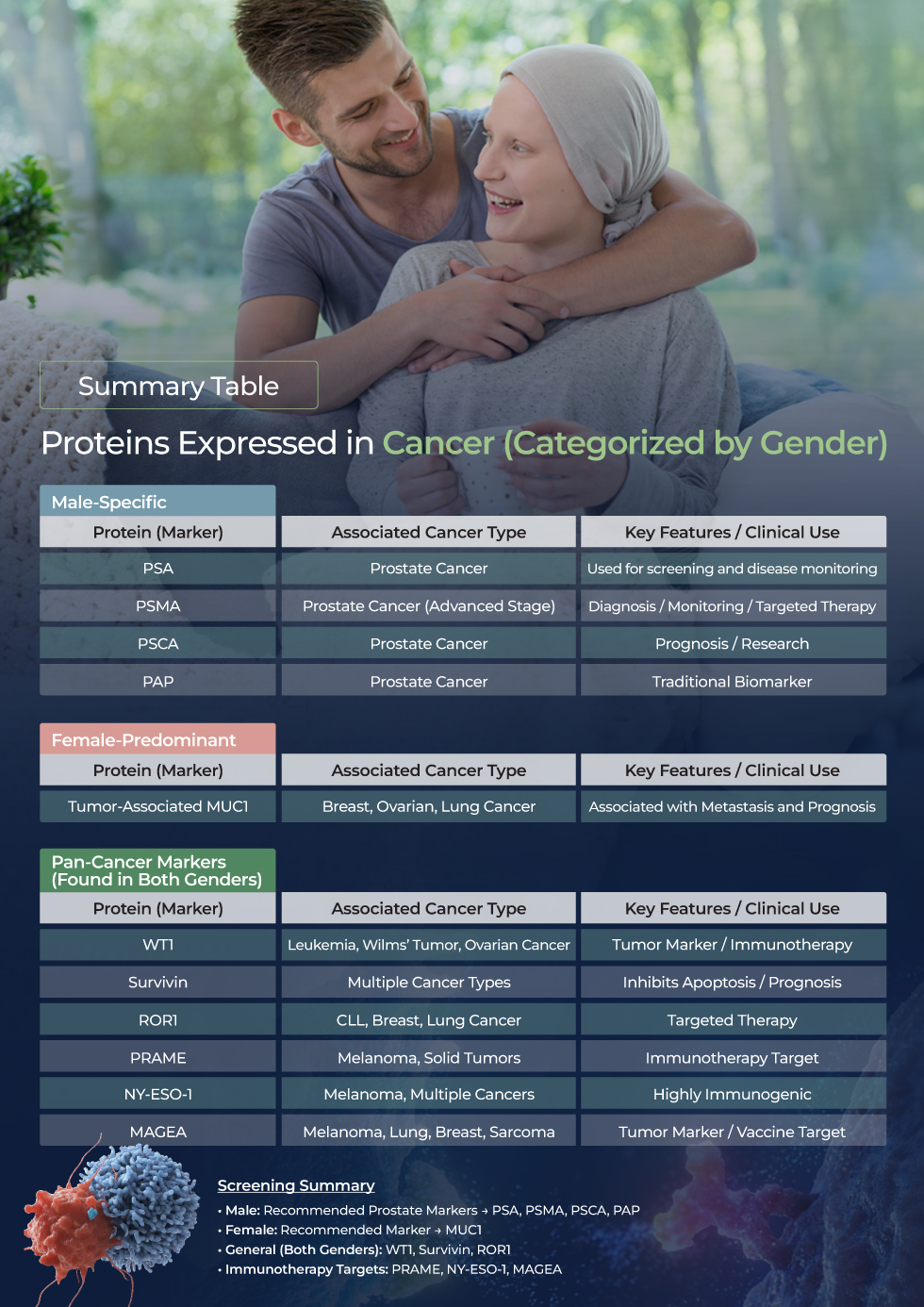
WT1 is a gene that encodes a transcription factor involved in cell growth and development. It is highly expressed in several cancers and is widely used as a tumor marker, particularly in leukemia and Wilms’ tumor. WT1 is also an important target in the development of cancer immunotherapy.
Tumor-associated MUC1 is an abnormal cell surface protein expressed in cancer cells. Compared with normal cells, it is often overexpressed, loses normal cell polarity, and exhibits reduced glycosylation, exposing new epitopes. These changes are associated with poor prognosis, enhanced tumor growth, cell survival, metastasis, and cell adhesion. MUC1 is used as a tumor marker in several cancers, including breast cancer, lung cancer, and ovarian cancer.
PRAME is a cancer-testis antigen that is highly expressed in melanoma and several other malignant tumors, while its expression in normal tissues is largely restricted to the testis.
PAP is an enzyme produced by the prostate gland and serves as a biomarker associated with prostate diseases, particularly prostate cancer.
NY-ESO-1 is a member of the Cancer-Testis Antigen (CTA) family. It is normally expressed in testicular tissue but not in most other normal tissues. However, it can be abnormally expressed in many types of cancer.
PSA is a protein produced by cells of the prostate gland. It can be measured in the blood and is a major biomarker used in the assessment of prostate disease.
PSMA is a cell surface protein highly expressed in prostate cells and markedly upregulated in prostate cancer, particularly in advanced disease. Its expression is associated with disease severity, making it a valuable tumor marker for diagnosis and disease monitoring.
PSCA is a cell surface antigen expressed in prostate cells and classified as a tumor-associated antigen. It is highly expressed in prostate cancer and is associated with tumor growth, proliferation, metastasis, disease stage, and severity. It is also being studied as a marker for prognostic evaluation.
ROR1 is a cell surface receptor belonging to the receptor tyrosine kinase-like family. It plays an important role in embryonic development but is also highly expressed in many cancers. It is associated with tumor growth, survival, migration, and metastasis, and has been identified in cancers such as chronic lymphocytic leukemia (CLL), breast cancer, and lung cancer.
MAGEA belongs to the Cancer-Testis Antigen family and encodes proteins expressed in many cancers, while normal tissue expression is largely restricted to the testis. It is found in cancers such as melanoma, lung cancer, breast cancer, and sarcoma.
Survivin is a member of the Inhibitor of Apoptosis Protein (IAP) family. It plays a major role in inhibiting cell death and regulating cell division. Although highly expressed during embryonic development, survivin is abnormally overexpressed in many cancers. Its presence promotes tumor cell survival, proliferation, aggressiveness, and treatment resistance. Clinically, survivin is used as a tumor marker and may assist in prognostic assessment.